People Ridge Again 30 Seconds to Mars
| 30 Seconds to Mars | ||||
|---|---|---|---|---|
 | ||||
| Studio album past Thirty Seconds to Mars | ||||
| Released | August 27, 2002 (2002-08-27) | |||
| Recorded | 2001–2002 | |||
| Studio |
| |||
| Genre |
| |||
| Length | 53:07 | |||
| Label |
| |||
| Producer |
| |||
| 30 Seconds to Mars chronology | ||||
| ||||
| Singles from 30 Seconds to Mars | ||||
| ||||
30 Seconds to Mars is the debut studio album by American stone band Thirty Seconds to Mars. It was first released on August 27, 2002, by Immortal Records and distributed past Virgin Records. The anthology was produced by Bob Ezrin, Brian Virtue, and Thirty Seconds to Mars, and was recorded in rural Wyoming during 2001 and early 2002. It had been in the works for a couple of years, with lead vocalist Jared Leto writing the majority of the songs.
30 Seconds to Mars was described as a concept album centering on human struggle and self-determination, characterized by personal lyrics that use otherworldly elements and conceptual ideas to illustrate a truthful personal situation. The album incorporates progressive sounds with influences and elements from new moving ridge, space rock, and electronica. Upon release, thirty Seconds to Mars received mostly positive reviews from music critics, who commended the anthology's lyrical content and the band's musicianship, which has been compared to the works of Pinkish Floyd, Tool, and Brian Eno.
The album debuted at number 107 on the Billboard 200 and number 1 on the U.s. Top Heatseekers. Information technology was a slow-called-for success that eventually sold two 1000000 copies worldwide. It produced two singles, "Capricorn (A Brand New Name)" and "Edge of the World". Xxx Seconds to Mars promoted the anthology past opening concerts for bands such as Puddle of Mudd, Incubus, Sevendust, and Chevelle.
Background and recording [edit]
By 1998, 30 Seconds to Mars was performing gigs at small American venues and clubs. When they first started, lead vocalist Jared Leto did not allow his vocation equally a Hollywood histrion to be used in promotion of the ring.[1] They played their first concerts nether unlike names, before finally settling on the name "30 Seconds to Mars", which was taken from a rare manuscript titled Argus Apocraphex.[2] During this period, the band recorded demo tracks such every bit "Valhalla" and "Revolution", or "Jupiter" and "Hero", which afterward appeared on the debut anthology as "Fallen" and "Year Zero" respectively, just also "Buddha for Mary".[three] Their piece of work led to a number of record labels existence interested in signing Xxx Seconds to Mars, which somewhen signed to Immortal Records.[4] In 1999, Virgin Records entered into the contract.[5]
The work of Thirty Seconds to Mars generated the interest of record producer Bob Ezrin, who had previously worked on several groundbreaking projects, including The Wall by Pink Floyd, Dear It to Expiry by Alice Cooper, and Destroyer by Buss. Thirty Seconds to Mars contacted Ezrin because they felt that he had the ability to assist them attain their own vision and create a distinct sound; moreover, the ring's members grew upwardly listing to his work with Pinkish Floyd, Kiss and Alice Cooper.[6] Brian Virtue, who had previously worked with Jane's Addiction, joined the band and Ezrin in producing the record.[7]
Thirty Seconds to Mars retreated to the isolation of Wyoming'southward countryside in 2001 to tape the anthology, tentatively titled Welcome to the Universe.[viii] The ring and Ezrin chose an empty warehouse lot on xv,000 acres, starting an intense period of preproduction focused on l songs.[7] The isolation immune the ring to piece of work at a different footstep. Jared Leto said that while recording in Wyoming, "there was an interesting dichotomy, a kind of contradiction with the applied science and the organic earth that nosotros were surrounded [...] Information technology'southward something that I call back concluded upwardly in the music".[6] Ezrin helped the ring to empathise the importance of an album's structure and how to create a progression, rather than a simple series of singles. "We really wanted to create something that had depth," Leto explained.[9] He described the process of working with Ezrin every bit tumultuous but also fulfilling, having its ain dynamics.[6] He also stated that Virtue was a key element in helping the band define their sound.[9] Although bassist Matt Wachter was a ring member at the time, the majority of the bass tracks were recorded by Jared Leto, with Wachter only being credited as a band member.
The rails "Fallen", originally titled "Jupiter", was the outset to be produced for the anthology. Thirty Seconds to Mars initially thought to exclude the rail from the record since they were not satisfied with information technology, but then they decided to rework the song because there were people who had strong feelings about information technology.[9] The track features programming past Danny Lohner and background vocals by Maynard James Keenan. Several musicians, including Elijah Blue Allman, Renn Hawkey, equally well every bit producers Ezrin and Virtue, contributed on selected tracks.[10]
Composition [edit]
Style and influences [edit]

The manner of the album combined progressive metallic and space stone with influences and elements from new moving ridge and electronica, utilizing programming and synthesizers.[11] [12] According to Jared Leto, the band wanted to create "something that had cohesiveness and kind of an atmospheric musical story to information technology".[xiii] He identified groups that had a sense of identity and atmosphere as being influential on the album's songwriting. He cited classic stoner rock artists, to which he and his brother Shannon had listened while growing up. Somewhen, they gravitated toward more conceptual work like Pink Floyd, David Bowie and The Cure.[14] Thirty Seconds to Mars too drew influences from acts such equally Björk, Rush, and Depeche Mode; according to Shannon Leto, the inspirations derived from "more often than not big conceptional bands; bands that had depth; bands that were dynamic".[ix] [xv]
The audio of 30 Seconds to Mars takes on many musical stylistic shifts. Elizabeth Bromstein from Now mag described it as a concoction of '80s electronics, industrial music and nu metallic with a heavy dose of progressive stone.[sixteen] Jaan Uhelszki of Alternative Press felt that the anthology is fabricated of "sterner stuff", with the ring'southward prog-metallic foundation "enhanced by an unexpectedly powerful sense of melody".[17] Smiley Ben of BBC Collective noted in the anthology alternative stone tendencies.[18] Ryan Rayhill from Blender found the album befitting prog-rock prototypes Rush and opined that Xxx Seconds to Mars "emerged with an eponymous debut that sounds similar Tool on The Dark Side of the Moon", referring to the 1973 album by Pink Floyd.[xi]
Lyrics and themes [edit]
xxx Seconds to Mars is a concept album focusing on human struggle and self-determination.[9] It deals with characters who battle with social alienation, emotional isolation, and political malaise. The title itself "thirty Seconds to Mars" indicates the accelerated human society and suggests a potential escapism from it.[seven] The album's lyrics depict the personal human experience through the utilise of metaphors and moments of fantasy. Jared Leto regarded it as a "very personal anthology that sometimes uses otherworldly elements and conceptual ideas to illustrate a truthful personal state of affairs".[9] He cited the human struggle as the nearly inspiring source for the band and explained that the tape features "a definite desire for change, for renewal, for a new kickoff and ultimately, for escape".[19] Author Karin Lowachee commented that Leto, who wrote near of the lyrics, allows the listener to draw his or her own conclusions to the meanings of the songs. She noted that "this makes the music especially personal, equally whatever images you conjure from the sound and words can be interpreted by your own inner language".[20]
Opening track "Capricorn (A Make New Proper noun)" deals with a desire for renewal. Leto, however, stated that he prefers to let the listener take its own understanding and meaning from the vocal, claiming that the interpretation, from individual to individual, is one of the most interesting aspects of music.[9] The rails "Fallen" faces the necessity to escape from the inner world that every person has created for itself.[6] The lyrics of "Oblivion", originally titled "The Reckoning", lead into a frantic threat, in which "Unity divides / Division will unite". Leto described this paradox as a rather common but unfortunate occurrence.[seven] [9] A dramatic narration drives "Buddha for Mary", whose story is non most a specific person and represents a metaphor. "End of the First" features a foreboding tone and emphasizes the human being nature in constant search for something.[9] The album ends with the hidden track "The Struggle", whose lyrics were taken from the ancient Chinese armed forces treatise The Art of State of war, attributed to Sun Tzu.[21]
The track "Revolution", excluded from the concluding track listing, was considered by some critics as having an anti-American tone. Leto rejected the claim and explained that information technology can be taken "many different ways" and if taken literally or politically, it could be misinterpreted. He said that the band "didn't desire a vocal like that to overshadow what we are about" and especially afterward the September 11 attacks, they felt information technology did not fit thematically with the residual of the anthology, stating that "information technology took on new dimensions".[9] The anthology features elements inspired by the scientific discipline fiction novel Dune past Frank Herbert, which influenced the anthology's songwriting for its themes regarding the interactions of politics, religion, engineering science, and homo emotion.[20]
Packaging [edit]
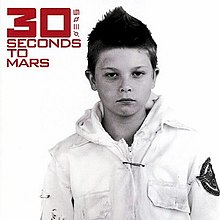
The photography for the album was handled by drummer Shannon Leto, with additional works provided past Ken Schles.[10] The comprehend fine art features a teenage boy and some of the band's symbolism. It includes a phoenix logo, named "Mithra" by the band, that bears the motto "Provehito in Altum". Roughly translated from Latin, the phrase means "Launch along into the deep". The band chose a phoenix for its association with rebirth and renewal in the Greek mythology.[22] The group expressed involvement in signs and symbols and their relationships with cultures and subcultures.[13] The album's cover art was unveiled through the band'due south official website on July 29, 2002.[23] Nevertheless, information technology was not conceived to be the original concept for the artwork. The initial cover art was discontinued and destroyed during product following the September 11 attacks due to the graphic content of the image.[24] Information technology featured a fighter pilot ejecting from an exploding airplane. Thirty Seconds to Mars explained that they never saw it as a vehement image, just felt that it was inappropriate in the wake of the events.[25]
Release and promotion [edit]
30 Seconds to Mars was released on August 27, 2002, on Immortal Records in the Usa and September 30 on EMI in the United kingdom. Information technology was originally expected to exist released in early 2002.[26] However, the ring was backside schedule and the embrace design needed a reshoot.[24] The album's compact disc featured enhanced material developed by Little Lion Studios, including a promotional video titled "Capricorn" directed by Lawton Outlaw, and a behind the scenes footage edited by Ari Sandel.[10] The Japanese edition of the album included the bonus track "Anarchy in Tokyo".[27] "Capricorn (A Brand New Name)" was the offset single taken from 30 Seconds to Mars. It was issued a month before the album'southward release on July 23, 2002.[28] It had an accompanying music video directed by Paul Fedor.[29] "Edge of the Earth" was released as the album's second single on January 28, 2003, with a music video directed by Kevin McCullough.[30]
After 5 years since its original release, 30 Seconds to Mars was made bachelor in Australia on April vii, 2007, on Virgin Records.[31] EMI re-issued a limited edition of the album in Japan on December 2, 2009.[32] To commemorate the 10th ceremony of the album, 30 Seconds to Mars hosted an event chosen MarsX on August 27, 2012. It was circulate worldwide through the online platform VyRT and included alive playback and commentary of the tape with the band, interactive discussion focused on the germination of Thirty Seconds to Mars, and exclusive audio-visual performances.[33] The album was too re-issued as a express edition motion-picture show disc.[34] To celebrate the 60th ceremony of the long-playing vinyl, Universal Music re-issued a double LP of 30 Seconds to Mars on September 23, 2016.[35] A re-release on red translucent vinyl was pressed the following year in a limited edition for the 15th anniversary of the anthology.[36]
Touring [edit]
The band promoted the album through a number of tours in North America. Fifty-fifty earlier its release, Puddle of Mudd invited Xxx Seconds to Mars to open a six-week tour for them in the spring of 2002.[37] On Jan xxx, Thirty Seconds to Mars began a promotional tour in North America. The ring played its offset European concert on June 24, 2002, at The Barfly in London, England.[38] In July 2002, they began a club tour and also embarked on a N American bout supporting Incubus.[39] In early October, they were invited by MTV to join the Campus Invasion Tour, playing ten dates in Canada alongside I Mother Earth, Baton Talent, and Pepper Sands.[40] The band was too scheduled to open a leap bout for Adema just was forced to withdraw due to scheduling conflicts.[41]
After playing a series of shows supporting Our Lady Peace, 30 Seconds to Mars opened an fall tour for Sevendust.[42] The ring's outset advent on television was on Last Phone call with Carson Daly on Nov 18, which aired on November 27, 2002. It was the last functioning with guitarist Solon Bixler, which left the band due to issues primarily related to touring. The ring later performed on The Tonight Evidence with Jay Leno and The Belatedly Late Evidence with Craig Kilborn, which marked the first alive operation with guitarist Tomo Miličević.[43] In 2003, the band went on tour with Chevelle, Trust Visitor, and Shihad, and played thirteen shows for Lollapalooza.[44]
Critical reception [edit]
| Review scores | |
|---|---|
| Source | Rating |
| Alternative Press | favorable[45] |
| BBC Collective |   [xviii] [xviii] |
| Blender | [11] |
| Eastward! Online | B[46] |
| Exclaim! | eight/10[47] |
| The Gazette |  [48] [48] |
| Kludge | vii/10[49] |
| Melodic | [l] |
| Now | 3/five[16] |
| Rolling Stone | [51] |
30 Seconds to Mars earned mostly positive reviews upon release.[52] At Metacritic, which assigns a normalized rating out of 100 to reviews from mainstream critics, the album received an average score of 60, based on 5 reviews.[46] Jason Pettigrew from Alternative Press regarded it as "an ambitious, immense-sounding work that'southward at once rich in tune" and "lyrically jarring".[45] Ryan Rayhill from Blender noticed "throbbing synths" and "exploding guitars", and called the album a "high-minded infinite opera of epic scope" narrating "tales of living in deep, blackness oblivion".[11] Smiley Ben of BBC Collective described the overall sound as "certainly compelling", and praised the sonic variety, writing that the band "knowingly push[es] boundaries" producing "great music with an edge".[18] AllMusic reviewer Jon O'Brien chosen the record a "highly aggressive space-themed concept anthology", and commended its "heavy, riff-laden" guitars, "soaring" vocals and sci-fi lyrics.[53]
Johan Wippsson from Melodic claimed that the band has "something new to add together to the world" with their space-influenced modernistic rock.[50] Jeremy Gladstone of Kludge commented that the anthology reaches its tiptop with "Buddha for Mary", which he called a "virtual sonic achievement", but felt that the quality of the songs drops off at the halfway point, describing the entire project as "top-heavy".[49] Canadian critic Karin Lowachee found the group'southward audio and vision reminiscent of their "concept-styled forbears" but "uniquely endemic" for a contemporary audience, and wrote that the band "defies the tendency by stepping out alee of information technology and into the future", giving the listener something original to enjoy.[54] Amber Authier from Exclaim! echoed this sentiment, stating that the band stretched musical borders and represented something that is "a little different", offering a "solid audio".[47]
Mitch Joel from Blistering commended the band's musical diversity, noting that they are "worth more than about of their peers on a song-by-vocal magnitude."[55] Elizabeth Bromstein of At present mag institute the runway-to-track variation limited, although she appreciated the range of styles.[sixteen] Peter Relic of Rolling Stone gave a mixed response, stating that the anthology has its finer moments simply felt that information technology is undone past Jared Leto's "baffling, pretentious poesy" and the "sanitized quality of the heavy guitars.[51] Q mag described it as having "a polished sheen", but opined that the "earnest, sci-fi-tinged lyrics gets monotonous" over the course of the anthology.[46] In contrast, Jason D. Taylor from AllMusic commented that the "infinite-age themes complement the group's avant-garde musical achievements wonderfully".[56] Megan O'Toole of The Gazette felt that every track on the album is a "unique masterpiece that simultaneously operates on a number of different musical and spiritual levels", writing that its music has the potential to "impact and infect the deepest recesses" of the soul.[48]
Commercial performance [edit]
In the U.s., thirty Seconds to Mars entered the Billboard 200 at number 107 on the upshot dated September xiv, 2002.[57] It likewise debuted at number one on the Elevation Heatseekers. After nine weeks, it vicious to number forty, with sales of over twoscore,000 units.[58] Every bit of August 2006, Nielsen SoundScan estimates actual sales of the anthology at over 120,000 in the United states.[59] Its lead unmarried, "Capricorn (A Make New Name)", entered the Mainstream Stone Tracks chart at number 40 and eventually reached a superlative of number 31.[60] In the United Kingdom, although the album never charted, information technology was certified silver by the British Phonographic Industry (BPI) in July 2013, denoting shipments of over 60,000 units.[61]
In France, 30 Seconds to Mars debuted at number 142 on the national albums chart on October 5, 2002.[62] Afterwards its release to the Australian market, the album entered the ARIA Charts at number 95 on the outcome dated June 11, 2007. It peaked at number 89 the following week.[63] In Hellenic republic, information technology entered the national albums chart in June 2011, in view of a ring'southward concert held in Athens in July, reaching a peak of number 41.[64] 30 Seconds to Mars was a slow-called-for success, and eventually sold two million copies worldwide as of March 2011.[65]
Legacy [edit]
Jason D. Taylor of AllMusic considered the release of 30 Seconds to Mars a "daring new pace in musical evolution" and noted that its impact left "vast corridors of sound open for the listener to meander downward at will". He commented that Thirty Seconds to Mars managed to tape an album that "breathes life" into the "empty shell that corporate stone has become", and felt that in "reanimating an artery of musical expression that has for many years been on its deathbed", the ring possibly offered the all-time rock experience of 2002.[56] thirty Seconds to Mars was named i of the all-time albums of 2002 past a number of publications, including CMJ New Music Report, Kludge, Melodic, and Metal Hammer.[66] Johan Wippsson of Melodic regarded it every bit "one of the most unique anthology when information technology comes to an ain style", while music critic Megan O'Toole from The Gazette felt that the band managed to "carve out a unique niche for themselves in the rock realm".[50] [48]
A writer of MuchMusic called the anthology a "work that is built to last", noting that the band produced "something unique" with "depth and substance".[7] Artistdirect agreed and explained that 30 Seconds to Mars established the group every bit "fresh, new force", revealing a "multi-faceted outfit that thrived on creative exploration and escape".[67] Jon O'Brien, writing for AllMusic, labelled the album one of the "more convincing actor-turned-rock star" efforts.[53] In a retrospective review in 2012, Ian Winwood from Kerrang! deemed the tape an "ballsy starting point" for the music that followed, and stated that information technology displayed Jared Leto's "vast, cinematic writing style". He considered its music "undoubtedly the near aggressive they've created" and regarded lead single "Capricorn (A Brand New Proper name)" every bit the band's "about muscular moment".[24]
Track list [edit]
All tracks are written by Jared Leto, except where noted.
| No. | Title | Length |
|---|---|---|
| 1. | "Capricorn (A Brand New Name)" | 3:53 |
| 2. | "Edge of the Earth" | 4:37 |
| 3. | "Fallen" | 4:59 |
| 4. | "Oblivion" | three:29 |
| 5. | "Buddha for Mary" | 5:45 |
| half dozen. | "Echelon" | 5:49 |
| 7. | "Welcome to the Universe" | 2:40 |
| viii. | "The Mission" | four:04 |
| 9. | "End of the Commencement" | 4:39 |
| 10. | "93 Meg Miles" | five:20 |
| 11. | "Year Null" (includes the subconscious rail "The Struggle": Jared Leto, Shannon Leto) | 7:52 |
| Total length: | 53:07 | |
| No. | Title | Length |
|---|---|---|
| 11. | "Year Zero" | four:44 |
| 12. | "Anarchy in Tokyo" (includes the hidden track "The Struggle": Jared Leto, Shannon Leto) | 7:35 |
| Total length: | 57:52 | |
| No. | Championship | Length |
|---|---|---|
| i. | "Capricorn" (Flash Video) | iii:33 |
| 2. | "Behind the Scenes Footage" | v:52 |
Personnel [edit]
Credits adapted from 30 Seconds to Mars album liner notes.[10]
| Thirty Seconds to Mars
Additional musicians
| Production
|
Charts and certifications [edit]
Weekly charts [edit]
| Certifications [edit]
| |||||||||||||||||||||||||
Release history [edit]
Notes [edit]
- ^ Tagliaferro 2006, p. 38.
- ^ "Matt Wachter, Tomo Milicevic – xxx Seconds to Mars". Face. June 28, 2006. Archived from the original on September 10, 2007. Retrieved August 29, 2013.
{{cite web}}: CS1 maint: unfit URL (link) - ^ Poncet 2002, p. 41.
- ^ LaGambina 2002, p. 20.
- ^ Paine, Andre (Baronial 18, 2008). "Virgin Sues 30 Seconds To Mars For $xxx Million". Billboard . Retrieved August 29, 2013.
- ^ a b c d LaGambina 2002, p. 21.
- ^ a b c d due east "30 Seconds to Mars". MuchMusic. Bell Media. Archived from the original on October 22, 2002. Retrieved May 16, 2014.
- ^ "In the Studio". Virgin Records. May 23, 2001. Archived from the original on December xiii, 2003. Retrieved May 16, 2014.
- ^ a b c d e f g h i j Redmon, Jess (May 10, 2002). "30 Seconds To Mars: Welcome To Their Universe". Shoutweb.com. Archived from the original on Apr xxx, 2008. Retrieved August 29, 2013.
- ^ a b c d xxx Seconds to Mars (booklet). Thirty Seconds to Mars. Immortal Records. 2002. 12424.
{{cite AV media notes}}: CS1 maint: others in cite AV media (notes) (link) - ^ a b c d Rayhill, Ryan (September 2002). "thirty Seconds to Mars". Blender (9): 142. Archived from the original on August 13, 2004. Retrieved November 25, 2015.
- ^ Gordon, Jay. "30 Seconds To Mars". D1 Music. Archived from the original on Jan 4, 2003. Retrieved May xviii, 2014.
- ^ a b O'Toole, Megan. "30 Seconds to Build a Make New World". The Gazette. 96 (vi). Archived from the original on November 28, 2002. Retrieved November five, 2014.
- ^ Niccum, Jon (Dec 6, 2002). "Jared Leto shuffles from movies to rock music". Lawrence.com. Retrieved November 21, 2015.
- ^ "Welcome to the Universe". Infamous Souls. October 25, 2002. Archived from the original on August 25, 2003. Retrieved April 18, 2014.
- ^ a b c Bromstein, Elizabeth (Nov 21, 2002). "30 Seconds To Mars". Now . Retrieved November 21, 2015.
- ^ Uhelszki 2002, p. 19.
- ^ a b c Ben, Smiley (April 18, 2004). "xxx Seconds to Mars". Collective. BBC. Archived from the original on February x, 2005. Retrieved August 19, 2010.
- ^ LaGambina 2002, p. 22.
- ^ a b Lowachee 2003, p. 5.
- ^ Lowachee 2003, p. iv.
- ^ Williams, Jonathan (Baronial 2005). "xxx Seconds to Mars". Prick. Archived from the original on November 24, 2005. Retrieved November 20, 2015.
- ^ "Anthology Cover Design Finalized". Virgin Records. July 29, 2002. Archived from the original on Dec 13, 2003. Retrieved November 20, 2015.
- ^ a b c Winwood 2012, p. 22.
- ^ "Discontinued". Virgin Records. September thirteen, 2001. Archived from the original on Dec thirteen, 2003. Retrieved Nov 20, 2015.
- ^ "At the Helm". Virgin Records. September one, 2001. Archived from the original on December xiii, 2003. Retrieved Nov 21, 2015.
- ^ a b "30 Seconds to Mars" (in Japanese). Oricon. Retrieved May xiv, 2014.
- ^ "30 Seconds To Mars Prep Video". Shoutweb.com. July 11, 2002. Archived from the original on October xv, 2002. Retrieved May 29, 2014.
- ^ "Paul Fedor and Making videos with 30 Seconds To Mars". Buzznet. SpinMedia. March xi, 2008. Archived from the original on Jan 11, 2014. Retrieved November 21, 2015.
- ^ "Modern Rock Airplay Annal". FMQB. Archived from the original on March 22, 2013. Retrieved May 25, 2013.
- ^ a b "30 Seconds to Mars". Sanity. Archived from the original on May 30, 2014. Retrieved May xiv, 2014.
- ^ a b "30 Seconds to Mars (First Press Limited Edition) (Nihon Version)". YesAsia. Retrieved May 29, 2014.
- ^ "Gloat 10 Years of Life on Mars". The Hive. August eighteen, 2012. Archived from the original on August 24, 2012. Retrieved May 29, 2014.
- ^ a b "MARSX Self-Titled Vinyl Picture Disc". 30 Seconds To Mars Store. Archived from the original on March v, 2014. Retrieved May fourteen, 2014.
- ^ "30 Seconds To Mars "Cocky-Titled" and "A Beautiful Lie" Vinyl Reissue". The Vinyl Collective. August 23, 2016. Retrieved September 8, 2017.
- ^ "30 Seconds To Mars Limited Edition Vinyl". Universal Music. Archived from the original on September 9, 2017. Retrieved September eight, 2017.
- ^ Jordan, Chris (March 22, 2002). "Puddle Of Mudd Deliver No-Frills Stone At Philly Engagement". MTV. Viacom Media Networks. Retrieved May 26, 2014.
- ^ Brannigan 2010, p. 23.
- ^ "Incubus and 30STM Tour". Kludge. July 4, 2002. Archived from the original on May 31, 2004. Retrieved Nov 26, 2015.
- ^ "I Mother Globe Headline MTV Campus Invasion Tour". ChartAttack. September 4, 2002. Archived from the original on 2014-03-07. Retrieved May 26, 2012.
- ^ "Adema tour canceled". Virgin Records. May 23, 2002. Archived from the original on Dec 13, 2003. Retrieved May 26, 2014.
- ^ Campbell, Courtney (November 2002). "xxx Seconds to Mars". Earplugs Required. Retrieved May 26, 2014.
- ^ Anderson, Philip (April 19, 2006). "Interview with Tomo Milicevic and Matt Wachter of 30 Seconds to Mars". Kaos2000. Archived from the original on May 5, 2007. Retrieved Dec 13, 2012.
- ^ "Lollapalooza Tour Stops In Irvine". Rockdirt.com. Baronial 19, 2003. Retrieved August 6, 2010.
- ^ a b Pettigrew, Jason (June 2002). "30 Seconds to Mars". Culling Press (167).
- ^ a b c "Critic reviews for 30 Seconds to Mars". Metacritic. CBS Interactive. Retrieved August 19, 2010.
- ^ a b Authier, Amber (December 1, 2002). "30 Seconds To Mars". Exclaim! . Retrieved May eighteen, 2014.
- ^ a b c O'Toole, Megan (September 26, 2002). "xxx Seconds to Mars". The Gazette. 96 (17). Archived from the original on April 19, 2003. Retrieved May 29, 2014.
- ^ a b Gladstone, Jeremy. "thirty Seconds to Mars". Kludge. Archived from the original on Nov 25, 2003. Retrieved August 19, 2010.
- ^ a b c Wippsson, Johan. "xxx Seconds to Mars". Melodic. Archived from the original on September 23, 2013. Retrieved March 18, 2014.
- ^ a b Relic, Peter (September 19, 2002). "30 Seconds To Mars". Rolling Stone (905). Archived from the original on May 13, 2007. Retrieved November 25, 2015.
- ^ D'Averc, Rhiannon (July 26, 2015). "The v defining moments of thirty Seconds to Mars' career". AXS. Retrieved November 20, 2015.
- ^ a b O'Brien, Jon. "xxx Seconds to Mars". AllMusic. All Media Network. Retrieved May 26, 2014.
- ^ Lowachee 2003, p. 6.
- ^ Joel, Mitch. "30 Seconds To Mars (Virgin)". Blistering. Archived from the original on May 30, 2014. Retrieved June 22, 2016.
- ^ a b Taylor, Jason D. "30 Seconds to Mars". AllMusic. All Media Network. Archived from the original on September 18, 2010. Retrieved November 26, 2015.
- ^ "Billboard 200". Billboard. 114 (37): 83. September fourteen, 2002.
- ^ Ault 2002, p. xviii.
- ^ Lear 2006, p. 34.
- ^ "Mainstream Rock Tracks". Billboard. 114 (40): 85. October 5, 2002.
- ^ a b "British anthology certifications – xxx Seconds to Mars – 30 Seconds to Mars". British Phonographic Manufacture.
- ^ a b "Lescharts.com – 30 Seconds to Mars – 30 Seconds to Mars". Hung Medien. Retrieved May fourteen, 2014.
- ^ a b "The ARIA Report: Issue 902 (Week Commencing 18 June 2007)" (PDF). National Library of Australia. Archived from the original (PDF) on 2007-07-19. Retrieved May 14, 2014.
- ^ a b "Official Cyta – Top 50 Albums 24/2011". Hung Medien. Archived from the original on October 21, 2012. Retrieved November twenty, 2015.
- ^ Evans 2011, p. 29.
- ^ Stop of year critic lists:
- CMJ New Music Report: "The Year In Review". CMJ New Music Study. 74 (795): 44. December xxx, 2002.
- Kludge: "The Best of 2002". Kludge. Archived from the original on July 22, 2004. Retrieved November 25, 2015.
- Melodic: "All-time of 2002". Melodic . Retrieved March 29, 2014.
- Metal Hammer: "Acme xx Albums of 2002". Metal Hammer. Jan 2003.
- ^ "Thirty Seconds to Mars". Artistdirect. Retrieved November 26, 2015.
- ^ a b "xxx Seconds to Mars – Chart History: Billboard 200". Billboard . Retrieved June 28, 2013.
- ^ "xxx Seconds to Mars". Retrieved May 14, 2014.
- ^ "30 Seconds to Mars". Retrieved May 14, 2014.
- ^ "30 Seconds To Mars" (in Dutch). Bol.com. Retrieved May 14, 2014.
- ^ "30 Seconds To Mars" (in German). EMI Music Germany. Archived from the original on Oct ii, 2011. Retrieved May 14, 2014.
- ^ "xxx Seconds to Mars" (in Italian). EMI Records Italia. Archived from the original on May 14, 2014. Retrieved May 14, 2014.
- ^ "30 Seconds to Mars". 2002-09-thirty. Retrieved May 14, 2014.
- ^ "30 Seconds to Mars". Marbecks. Archived from the original on March 10, 2012. Retrieved May 14, 2014.
References [edit]
- Ault, Susanne (November 9, 2002). "Celeb Bands Reach for Stars". Billboard. Nielsen Business Media. 114 (45): 18.
- Brannigan, Paul (February 20, 2010). "The Home Front". Kerrang!. Bauer Media Group (1300): 22–26.
- Evans, Mark (March 2011). "Mars Attacks". What'southward on. Motivate Publishing (395): 29–thirty.
- LaGambina, Gregg (July 2002). "30 Seconds to Mars". The Album Network (96): 20–22.
- Lear, Courtney (August 26, 2006). "Mission to Mars: Blasts Off Again". Billboard. Nielsen Business organization Media. 118 (34): 34.
- Lowachee, Karin (2003). "Rock Gods of War: Space, Symbols, and Synth-Rock Imbue the Metaphoric Musical World of 30 Seconds to Mars". Mars Dust. Mysterian Media.
- Poncet, Emilie (October 2002). "Lost in Space". Rock Audio (106): 40–42.
- Tagliaferro, Lauren (June 23, 2006). "Tell Me – thirty Seconds to Mars". The Buffalo News. Berkshire Hathaway: 38.
- Uhelszki, Jaan (September 2002). "Rock Implosion". Alternative Press (170): 18–xix.
- Winwood, Ian (February 18, 2012). "10 Years of Life on Mars". Kerrang!. Bauer Media Grouping (1402): 20–23.
External links [edit]
- 30 Seconds to Mars at Discogs (list of releases)
yingsthinvallover.blogspot.com
Source: https://en.wikipedia.org/wiki/30_Seconds_to_Mars_(album)
0 Response to "People Ridge Again 30 Seconds to Mars"
Postar um comentário