Art Techniques of Egyptians Art Techniques of Egyptians With Paper Plates
A wide variety
Egyptian artists used a wide array of materials, both local and imported, from very early in their history. For instance, already in the Predynastic period we detect figurines carved from lapis lazuli—a lustrous blue stone that originates in what is now Afghanistan and indicates the early presence of robust trade routes.

Group of stones collected in Egypt showing the range of colors and textures available to the ancient artists.
Stone

Menkaure (Mycerinus) and Khamerernebty(?), graywacke, c. 2490-2472 B.C.E. (Museum of Fine Arts, Boston)
In that location were numerous native stones used for statuary, including the ubiquitous soft limestone of the desert cliffs that line most of the Nile valley, also as sandstone, calcite, and schist.
Harder stones include quartzite, diorite, granite, and basalt. Carving on softer stones was washed using copper chisels and stone tools; difficult stone required tools of notwithstanding harder stone, copper alloys, and the use of abrasive sand to shape them. Polishing was achieved with a smooth rubbing stone and annoying sands with a fine grit.
Painted statuary
Most statuary was painted; even stones selected for the symbolism of their color were often painted. For example, the exemplary statues of Menkare, builder of the smallest of the three major pyramids at Giza, were executed in dark schist (also chosen greywacke). This smooth blackness rock is connected with Osiris, resurrected god of the dead who was often shown with black or green skin referring to the fertile silt and lush vegetation of the Nile valley.
These images preserve traces of carmine paint on the king's skin indicating that, when completed and placed in his memorial temple about his pyramid, they would accept appeared lifelike in coloration. With time, the paint would have flaked away, revealing the black rock underneath and explicitly linking the deceased king with the Lord of the Underworld.
Wood
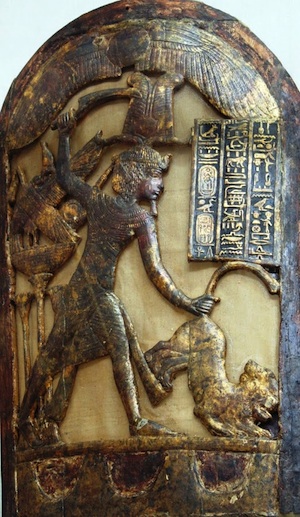
Formalism aureate wooden shield from the tomb of Tutakhamun. Egyptian Museum, Cairo (New Kingdom) (photograph: Dr. Amy Calvert)
Egyptian artists also used a variety of forest in their work, including the native acacia, tamarisk, and sycamore fig as well as fir, cedar, and other conifers imported from Syria. Artisans excelled at puzzling together small, irregular pieces of wood and pegged them into place to create statuary, coffins, boxes, and piece of furniture.
Metals
They besides executed pieces in various metals, including copper, copper alloys (such as bronze), aureate, and silvery. Cult statues of gods were fabricated in gilded and silver—materials identified by myth every bit their skin and bones—and were oftentimes quite small. Very few metal statues survive because they were often melted downward and the material reused, although preserved examples from the Quondam and Centre Kingdoms demonstrate that they were skilled not only in canvass metal forming, but also practiced complex casting.

Tutankhamun'south lunar pectoral in the Egyptian Museum, Cairo (New Kingdom) (photograph: Dr. Amy Calvert)
Jewelry work was quite sophisticated even in the Old Kingdom, as demonstrated by some highly creative pieces depicted in tomb scenes. A cache of royal jewelry from the tombs of Middle Kingdom princesses displays extremely high levels of skill in terms of pattern every bit well as precisely cut stone inlays, repoussé, and cloisonné
Many objects, peculiarly small amulets and inlays, were made from a manufactured textile known every bit Egyptian faience. This quartz-based medium could be easily shaped, molded, and mass produced. The glaze coating could be almost whatever color, depending on the minerals used in the limerick, although turquoise blueish is the most common.
Relief sculpture
Relief was ordinarily carved earlier beingness painted. The two primary classes of relief are raised relief (where the figures stand up up out from the surface) and sunk relief (where the figures are cut into and below the surface). The surface would exist smoothed with a layer of plaster and then painted. If the surface was not carved before painting, several layers of mud plaster would exist practical to create a flat aeroplane.
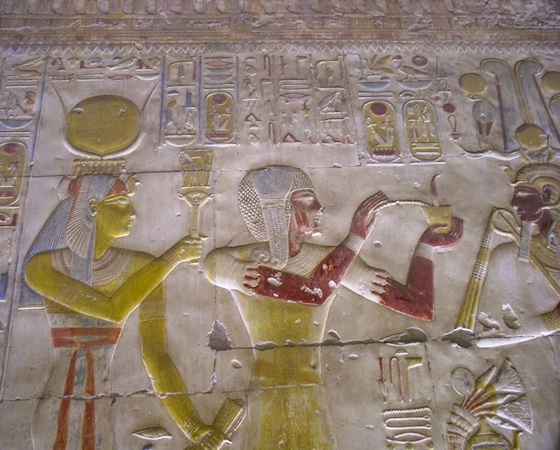
Painted raised relief in the Temple of Seti I at Abydos (New Kingdom)
The drawing surface would exist delineated using gridded guidelines, snapped onto the wall using cord coated in ruby-red pigment dust (very much similar chalk lines used by modern carpenters). This grid helped the artists properly proportion the figures and lay out the scenes. Scene elements were drafted out using red paint, corrections noted in blackness pigment, and so the painting was executed 1 color at a fourth dimension. Even on carved relief, many elements in a scene would exist executed merely in paint and not cut into the surface.

Iron oxide nodules, source of a range of reddish pigments, Thebes
Pigments
Well-nigh pigments in Egypt were derived from native minerals. White was oftentimes fabricated from gypsum, black from carbon, reds and yellows from iron oxides, blueish and green from azurite and malachite, and bright yellow (representing gilded) from orpiment. These minerals were ground then mixed with a institute or animal based mucilage to make a medium able to adhere to the walls. They could be applied as a single plane, only were also layered to create subtle effects and boosted colors, such as pink or grey.
Additional resources:
About quarrying
Paint like an Egyptian activity
Color symbolism in aboriginal Arab republic of egypt
Nicholson, P. & Ian Shaw, Ancient Egyptian Materials and Applied science (Cambridge University Printing, 2000)
Smarthistory images for instruction and learning:
More Smarthistory images…
yingsthinvallover.blogspot.com
Source: https://smarthistory.org/materials-and-techniques/
0 Response to "Art Techniques of Egyptians Art Techniques of Egyptians With Paper Plates"
Postar um comentário