Who Did Art on Marvin Gays I Want You Album
At the California African American Museum'due south retrospective dedicated to belatedly creative person and former NFL histrion Ernie Barnes, "The Sugar Shack" is an undeniable star.
Visitors often form a line effectually the painting, said the evidence's curator, Bridget R. Cooks, acquaintance professor in the departments of African American studies and art history at UC Irvine. They all expect for their moment with Barnes' work, a piece that entered pop-culture consciousness after appearing on the 1970s sitcom "Good Times" and every bit the encompass art to Marvin Gaye'southward 1976 album, "I Want You."
"The Sugar Shack" transports viewers to a jubilant black club. Vibrant, dancing partygoers and musicians fill up the three-by-4-foot canvas. Most accept their eyes closed, a signature in nearly all of Barnes' paintings, referring to his oft-stated conventionalities that "we are blind to each other'due south humanity."
Every bit a neo-mannerist who referenced the late Renaissance period of Leonardo da Vinci and Raphael, Barnes painted the figures in "The Carbohydrate Shack" every bit exaggerated and elongated forms, one man'southward artillery joyously nearly reaching the top of the canvas, another woman's curvy legs stretching halfway across the dance flooring. Barnes' expressive manner helps viewers place with the rhythm and sensuality of the painting, Cooks said.
One central figure in the painting is a adult female in a yellow dress and white shoes, dancing at the front of the tall stage, her back to the viewer. She'southward a character who appears in artworks throughout Barnes' career.
It's easy to get lost in the revelers, but a closer look reveals unexpected details. Nestled in a corner between the stairs and the stage is a black man in a blue uniform, sitting with a paper at his feet. Dissimilar the residual of the figures on the canvass his expression is downcast. He seems to be an outsider.
Cooks isn't certain if he'southward working security or if he'south an off-duty policeman relaxing with the music. But she compared the effigy to Jean-Michel Basquiat's 1981 piece of work "Irony of the Negro Policeman." "He'southward representing constabulary and order and we don't retrieve nearly the police being, peculiarly today, friends of the black community," Cooks said.
Barnes was born into a working-form family in segregated Durham, North.C., in 1938. He painted "The Carbohydrate Shack" from a childhood retentivity — sneaking into the Durham Arsenal, a venue that hosted segregated dances and that notwithstanding exists today. "This was a place where you could go every bit a black person and meet Knuckles Ellington and run into Clyde McPhatter," Cooks said. Barnes, who died in 2009, recalled in a 2008 interview that the experience was the "showtime time my innocence met with the sins of dance."
Later on beingness drafted by the Baltimore Colts in 1959, Barnes played professional football for teams including the Denver Broncos and San Diego Chargers until 1965, earlier pursuing his passion for art.
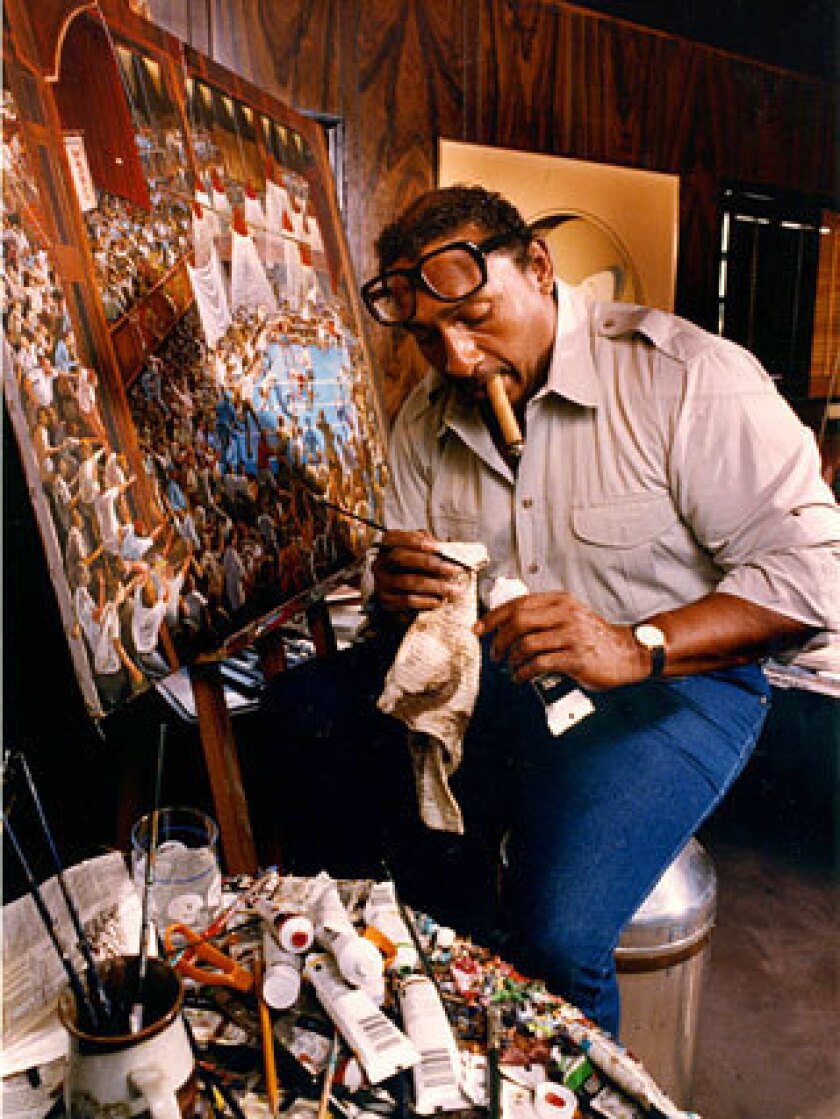
Ernie Barnes working in his studio in 1992.
(Ricardo DeAratanha / Los Angeles Times)
In the early on 1970s, Barnes settled in L.A.'s Fairfax district. He became interested in Jewish culture and was impressed with how much the community knew of its history, Cooks said. "And he really wished that blackness people had the same type of cultural education." Inspired by the "Black Is Cute" movement, he premiered his exhibition "The Dazzler of the Ghetto," 35 paintings depicting everyday scenes from black life, in 1972.
His piece of work during the time, including "The Carbohydrate Shack," was about "showing blackness equally beautiful and even exaggerating form," Cooks said. "It's not about trying to hide the curves of your body or the facial features that yous have. It'south nearly showing them, even exaggerating them and making it non even just OK only something to really be celebrated."
"The Sugar Shack" ascended into pop culture past chance.
Afterward Barnes played a game of basketball with Gaye, the soul singer caught a glimpse of Barnes' painting in his auto. "He went crazy and he was like I take to have this," Cooks said.
Barnes augmented the painting to include references to Gaye'south music, and the work became the cover of his "I Want You" anthology in 1976. That aforementioned year, Barnes painted a "Carbohydrate Shack" indistinguishable, which is on display at CAAM. According to a annotation written by the creative person, he created the second painting because the get-go "moved around, uninsured" and out of his control.
In the 1970s, producer Norman Lear commissioned Barnes to create original paintings for the Jimmie Walker grapheme J.J. in "Good Times," the sitcom about a black family living in a Chicago housing project. In later seasons "The Carbohydrate Shack" was the backdrop for the testify'southward credits.
The painting became part of American national memory, something of a mythical object, Cooks said. The curator believes Barnes would take found "The Carbohydrate Shack" selfie lines at CAAM to be meaningful.
"It's wonderful to see how much respect the painting commands," she said. "People actually understand this is a painting that in some ways belongs to everyone."
'Ernie Barnes: A Retrospective'
Where: California African American Museum, Exposition Park, 600 Country Bulldoze, Los Angeles
When: 10 a.1000.-5 p.m. Tuesdays-Saturdays, xi a.m.-5 p.1000. Sundays, through Sept. 8.
Admission: Free
Info:
https://caamuseum.orgyingsthinvallover.blogspot.com
Source: https://www.latimes.com/entertainment-arts/story/2019-08-27/ernie-barnes-sugar-shack-painting-at-caam
0 Response to "Who Did Art on Marvin Gays I Want You Album"
Postar um comentário